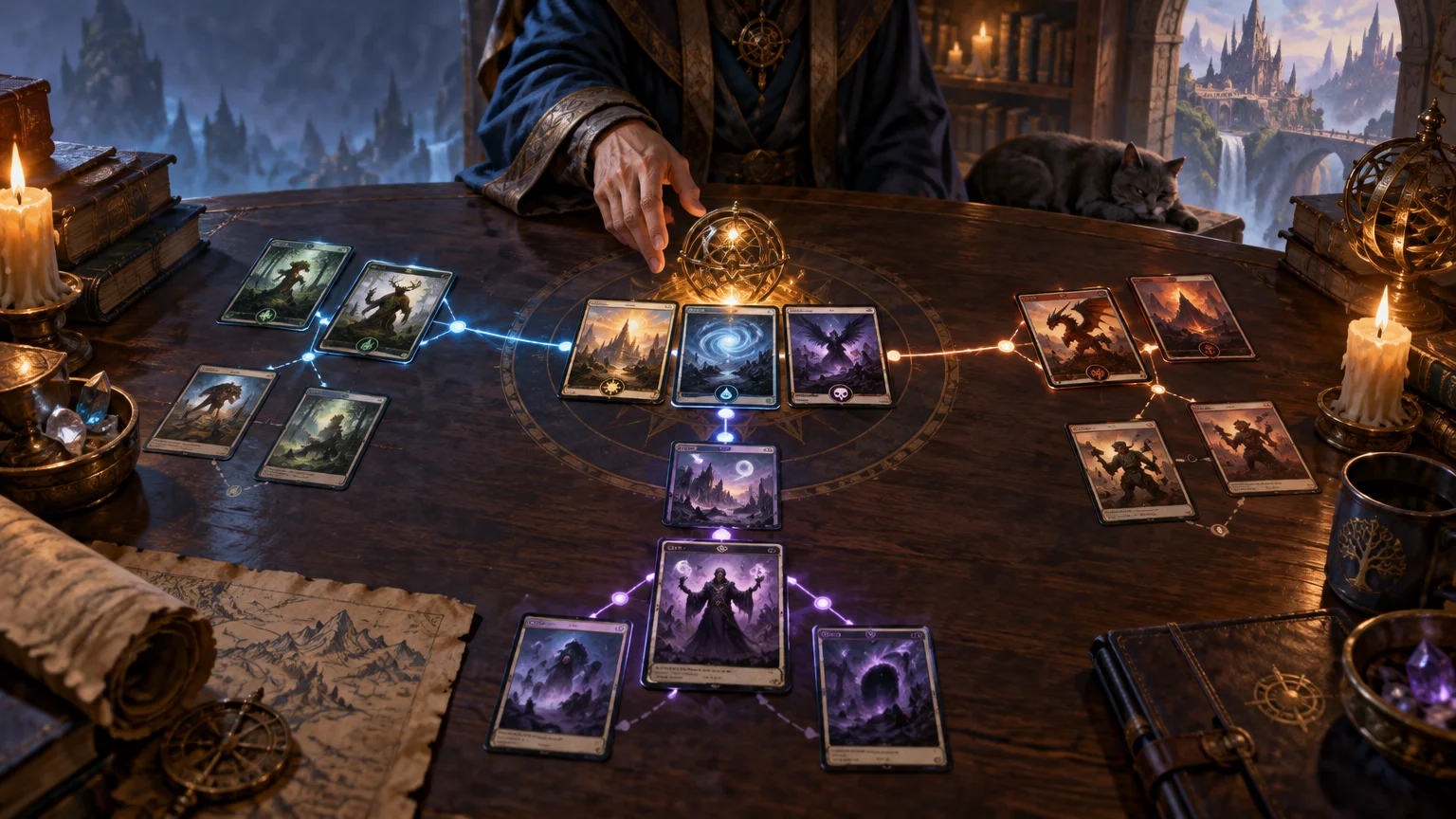
TLDR: MTG combo redundancy means giving a deck multiple viable ways to assemble its combo, usually through replacement pieces or overlapping lines. The best redundant packages share cards, preserve the required rules interactions, and leave fewer dead draws. Redundancy can broaden what your tutors find, but it does not literally increase tutor density. It also does not guarantee resilience when every variant loses to the same removal spell, hate piece, or counterspell.
A combo package is efficient when its cards form a network rather than several isolated piles. If Card A works with B, C, and D, while C also completes a line with E, the deck has more assembly paths without necessarily adding another full combo. That is the useful version of MTG combo redundancy: more acceptable combinations per slot, not a binder page of unrelated infinites wearing the same deck sleeves.
What combo redundancy actually means
Redundancy is often described as playing extra copies of an effect. That definition works in Constructed formats where a deck can use several copies of the same card, but Commander is generally singleton outside basic lands and cards whose text permits otherwise. That makes substitutes, overlapping roles, and alternate lines especially important. The official Commander format overview explains the format’s deck construction and current play-experience framework.
For combo analysis, it helps to separate three related ideas:
- Piece redundancy: Multiple cards can perform the same required mechanical role in a particular line.
- Line redundancy: The deck contains multiple complete routes to a desired result, such as infinite mana or a deterministic win.
- Threat-type diversity: Different lines rely on meaningfully different card types, zones, resources, or interaction points.
These are not interchangeable. Two creatures that replace one another may provide piece redundancy, but both can still fold to the same creature removal. Two graveyard loops may be separate lines, but a single graveyard-hate permanent could disable both. A deck becomes more resilient only when its alternatives survive different forms of disruption.
Map variants before adding cards
Start with one verified base line. A useful combo record includes every required piece, prerequisites, starting zones, activation costs, timing restrictions, repeated steps, and the resulting outcome. The MTG Combo Database supports searches using criteria such as card, format, color identity, combo size, outcome, and setup level, and its entries are structured around pieces, prerequisites, steps, and results.
Do not reduce that record to “A plus B goes infinite.” A replacement can appear similar while failing because the original card untaps itself, creates a specific permanent type, produces colored rather than colorless mana, or works from a zone the substitute cannot access. Exact wording is often the entire combo.
A simple variant map can expose those differences:
| Field | Question to record | Why it matters |
|---|---|---|
| Pieces | Which cards are strictly required? | Separates essential pieces from support cards. |
| Starting state | Where must each card be, and can summoning sickness matter? | Reveals setup that a short combo label may hide. |
| Resources | How much mana, life, or other material is needed? | Shows whether a substitute changes practical accessibility. |
| Result | Does the line win, create a loop, or only generate value? | Prevents ordinary synergy from being labeled a finisher. |
| Interaction points | Where can opponents interrupt the line? | Shows whether variants provide real resilience. |
| Restrictions | What timing, target, or deckbuilding limits apply? | Tests whether an apparent replacement actually functions. |
Once the base line is documented, add each proposed substitute as a separate variant. Change one component at a time. If changing one card also requires another enabler, more starting mana, and an extra combat step, it may still be a valid line—but it is not a clean one-for-one replacement.
Use a strict replacement-piece test
A functional equivalent is only equivalent for the job being measured. Two cards do not need identical text, but they must preserve the interaction that makes the line work.
- Identify the exact mechanical role. Is the card untapping a permanent, copying an ability, reducing a cost, creating a token, moving a card between zones, or converting one resource into another?
- Check the relevant zone. A card that triggers on entering the battlefield does not automatically replace one that functions from the graveyard or command zone.
- Compare timing and targeting. Sorcery-speed activation, once-per-turn text, target restrictions, and intervening-if clauses can stop a loop.
- Recalculate resources. Record changes to colored mana, total mana, life, cards, sacrifice fodder, counters, and required permanents.
- Check restrictions. Creature type, permanent type, mana value, controller, ownership, and “another” wording frequently matter.
- Confirm color identity and format legality. A mechanically valid substitute may not be legal in the intended deck.
- Verify the outcome. A line that creates arbitrarily large mana is not automatically a win unless the deck can use that mana to finish the game.
When exact Oracle wording or a rules corner case controls the result, consult Wizards’ official rules resources and current card text rather than relying on remembered wording. Wizards identifies the Comprehensive Rules as the detailed reference for rules questions.
If learning to recognize these roles feels easier than memorizing card names, that is the point. The guide to learning MTG combos as patterns provides a useful companion workflow for grouping cards by what they actually do.
How shared pieces improve slot efficiency
Suppose a hypothetical package has two isolated three-card combos. With no overlap, it consumes six slots, and drawing pieces from different lines may accomplish nothing. If both lines use the same engine card, the package requires five unique slots. If another card has a useful role in ordinary gameplay, the cost of including the package falls again—not mathematically, but in terms of dead-draw risk.
Shared pieces are most valuable when they satisfy at least two of these conditions:
- They participate in multiple complete, verified lines.
- They are acceptable tutor targets at different stages of assembly.
- They support the deck’s normal plan when no combo is available.
- They have manageable mana and color requirements.
- They do not make every line dependent on one fragile permanent or zone.
A card appearing in five database entries is not automatically efficient. Those entries may require five different support packages that do not belong in the deck. Count the lines that are viable within the actual list, not every theoretical interaction involving the card.
Redundancy improves tutor coverage, not tutor density
Tutor density is the number or proportion of cards that can search for relevant pieces. Adding a replacement combo piece does not increase that number. What it can improve is target breadth: more of the cards found by an existing tutor can advance a viable line.
Imagine a tutor that can find any creature. If a deck’s only creature-based combo target is Piece A, the tutor has one relevant target for that role. Adding Piece A2, which genuinely replaces A, gives the same tutor another acceptable target. If A2 also completes a second line, the tutor becomes more flexible still. The deck did not gain another tutor; its existing tutor gained better coverage.
That distinction matters when choosing between another tutor and another replacement piece. A tutor usually improves access to the best existing card but may cost mana and expose the deck to search restrictions or table expectations. A replacement can be drawn naturally and may keep a line alive after the original is removed, but only if it really performs the needed role.
| Add this | Prefer it when | Main tradeoff |
|---|---|---|
| Another tutor | The existing targets are strong, legal, and useful in several situations. | Raises search consistency and may increase perceived or actual deck power. |
| Another replacement piece | The deck needs natural redundancy or recovery after losing a key card. | Can become a weak draw if it has little use outside the combo. |
| Another overlapping line | Existing cards already provide most of the new line. | May add power efficiently but can create shared vulnerabilities. |
| Another standalone threat | The combo package is consuming too many narrow slots. | Improves plan diversity but does not directly help combo assembly. |
Audit shared failure points honestly
After mapping the lines, mark every interaction point. Group them by the kind of disruption that works: creature removal, artifact or enchantment removal, graveyard hate, activated-ability suppression, exile, stack interaction, or resource denial.
Then ask a blunt question: if an opponent presents one common answer, how many lines remain live? Four variants that all require the graveyard may provide assembly redundancy without providing meaningful resilience to graveyard hate. Three lines sharing one legendary creature may be slot-efficient while making that creature an obvious point of failure.
This is not necessarily a reason to remove the package. It is a reason to describe it accurately. A compact, tutor-friendly combo network can be excellent even when fragile. The deck simply needs a plan for protection, recovery, or winning another way.
A combo-database workflow for finding overlap
MTGApp describes a decklist-oriented workflow that can surface complete lines, one-piece-away lines, and cards shared across multiple combos. Use those categories as prompts for analysis rather than automatic recommendations.
- Enter or import the current list before searching for upgrades. Begin with what the deck already supports.
- Review complete lines and verify their prerequisites, steps, and outcomes. A technically complete line may still demand an unrealistic board state.
- Inspect one-piece-away lines. Prioritize missing cards that finish more than one viable line or also serve the deck’s normal plan.
- Open the variants and substitute information. Apply the replacement-piece test instead of assuming cards with similar summaries are interchangeable.
- Create a shared-piece map. For each combo card, record how many viable lines use it and which other pieces each route requires.
- Mark common failure points. Identify whether the alternatives actually diversify card types, zones, and interaction windows.
- Compare the proposed list with the original. Remove packages whose added cards are narrow, expensive, color-intensive, or disconnected from the main plan.
For a broader introduction to evaluating setup burden and payoff, see how to find combos and decide whether they are worth including. The goal is not to maximize the number displayed beside a decklist. It is to find the smallest coherent network that serves the deck’s intended game.
Check the deck around the combo package
A combo can be internally elegant and still make the surrounding deck worse. After changing the package, inspect the mana curve, color requirements, land balance, and opening hands. MTGApp states that its Deck Builder includes curve, color, and land analysis plus starting-hand playtesting. These are diagnostic tools, not proof that a list is correct.
Look for practical warning signs: too many cards that do nothing alone, an increase in expensive setup pieces, colored costs the mana base cannot reliably support, or opening hands containing mismatched halves of unrelated lines. Also check whether protection, card selection, and interaction were cut to make room. A deck that assembles goldfish combos beautifully but cannot participate in a real game has optimized the wrong spreadsheet.
Do not claim a consistency improvement from card count alone. Meaningful probability analysis requires assumptions about deck size, draw steps, mulligans, tutor restrictions, and the turn by which the combo must be available. In ordinary tuning, repeated opening-hand inspection and tracked games can reveal whether the package is helping, but conclusions should match the amount of evidence collected.
Commander power and table expectations
Compact overlapping packages can raise a Commander deck’s power even without increasing its nominal number of combos. Better tutor targets, one-card-away lines, and fewer dead slots make the deck more capable of assembling a finish. Wizards presents Commander brackets as an optional pregame framework based on intended play experience, and its guidance treats efficient tutoring for powerful cards as relevant to those expectations.
When discussing the deck before a game, describe what opponents need to know: whether it contains infinite or deterministic lines, how early it is intended to assemble them, and whether tutors regularly find the required pieces. “It only has two combos” is not very informative if both share pieces and nearly every tutor advances one of them.
Finally, check every included card against Wizards’ current Banned and Restricted list rather than relying on an old announcement or saved decklist. Legality, Oracle text, and Commander guidance can change.
Build a network, not a combo pile
The best next step is to map one existing line and evaluate every proposed replacement mechanically. Favor cards that complete several verified routes, remain useful outside the combo, and diversify rather than merely multiply failure points. Then inspect the revised curve, mana requirements, opening hands, and table fit.
That process turns redundancy into a deckbuilding decision rather than a combo count. More lines can be useful. More coherent ways to reach the right line are better.