
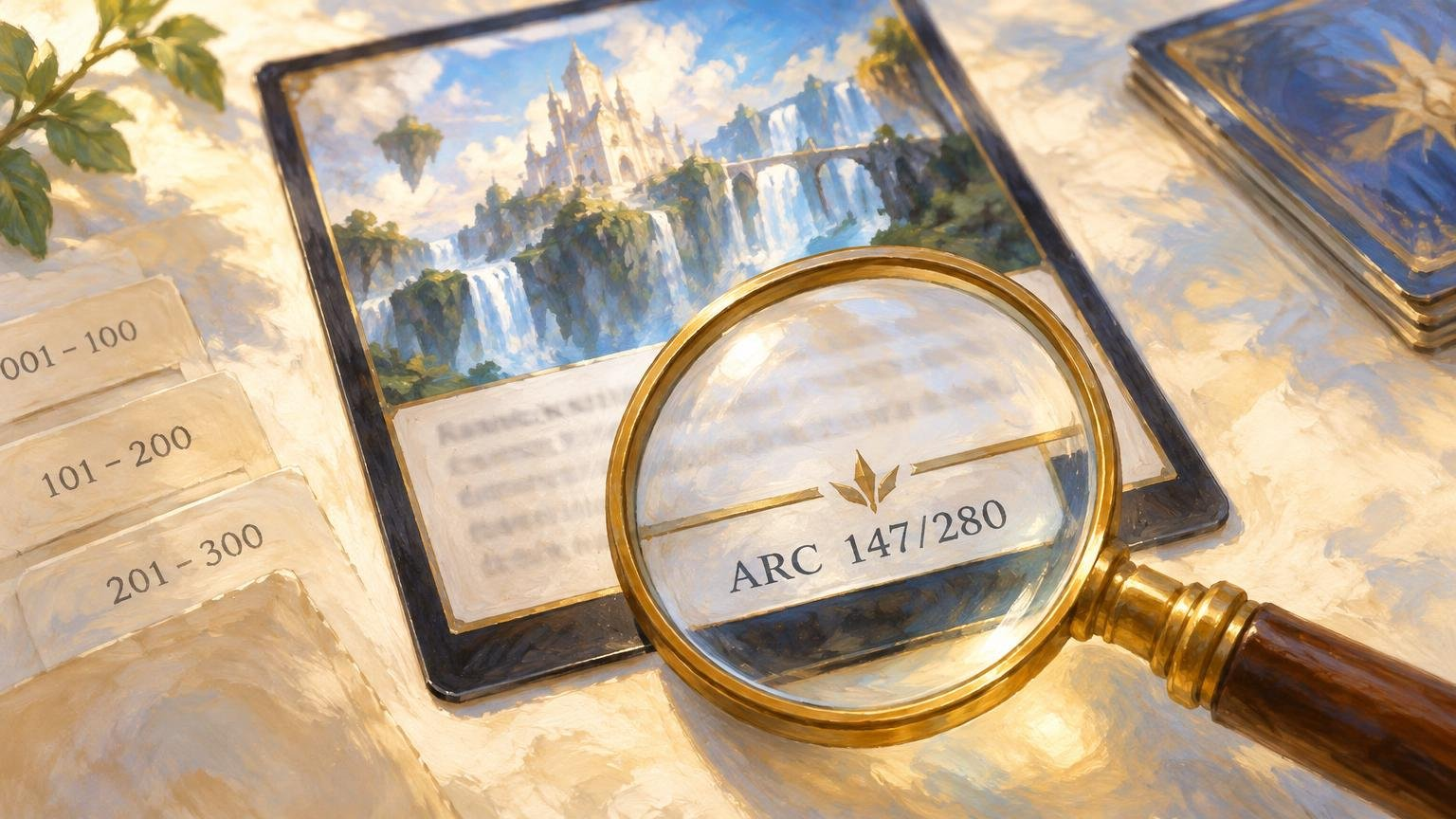
The fastest way to identify most Magic: The Gathering printings is to combine the card’s set code with its collector number. The set code identifies the release or product, while the collector number identifies an entry within that set’s numbering scheme. Search those two values together and you can usually skip the considerably messier process of comparing artwork, borders, copyright dates, and tiny expansion symbols.
The important qualification is “printing,” not necessarily “individual physical copy.” Language, foil treatment, promotional status, and serialization can require additional information. Think of the set-code-and-number pair as the primary database key a player can actually read from the card, then add other visible attributes when the card demands it.
What the set code and collector number tell you
A set code is a short identifier assigned to a particular set or related product. A collector number marks the card’s place or entry within that product’s numbering system. The expansion symbol is a separate visual marker; it may help you recognize a release, but it is not the same thing as the written set code.
Suppose the information line shows “122/269 R M15 • EN.” In the modern frame example published by Wizards, 122/269 is the collector number and stated set size, R is the rarity, M15 is the set code, and EN is the language. The useful lookup pair is therefore M15 plus 122.
The denominator is contextual rather than part of a universal card identity. The notation 122/269 means entry 122 within that printing’s stated numbering scheme of 269 cards. Another release can also contain a card numbered 122, which is why searching the collector number without the set code produces ambiguity.
| Printed detail | What it identifies | Why it matters |
|---|---|---|
| Set code | The set, release, or associated product | Separates entries that reuse the same collector number |
| Collector number | An entry in that set’s numbering scheme | Separates cards and treatments within the same set code |
| Language | The language version | Can distinguish cards sharing the same set code and number |
| Finish or treatment | Foil, nonfoil, etched, showcase, borderless, or another variant | May distinguish physical versions not fully described by the basic pair |
| Serialization stamp | A particular numbered copy | Goes beyond identifying the general printing or variant |
Where to find the identifiers on the card
On cards using the modern frame introduced with Magic 2015, look at the small information line in the lower-left corner. It normally groups the collector number, rarity, set code, and language in one place. The text is tiny because apparently identifying cardboard is also an eyesight exam, but it is usually more dependable than identifying an expansion symbol from memory.
On older cards, inspect the legal and copyright line near the bottom instead. Wizards’ card-anatomy guide says the collector number is typically positioned to the right of the legal text. The layout varies across eras, so do not expect the clean modern sequence on every old frame.
Some older cards and misprints lack collector numbers, and tokens do not always follow the same numbering conventions as regular game cards. When the number is absent, switch to a broader identification workflow using the card name, artwork, border, copyright line, expansion symbol, language, artist credit, and any promotional markings. Our guide to finding the set and printing of a physical MTG card covers that wider process.
The quickest lookup workflow
Start by transcribing what the card actually says. Do not infer the set from the artwork or replace an unusual collector number with what you think it should be. A reliable workflow takes less than a minute:
- Find the written set code in the lower information line or older legal line.
- Copy the collector number exactly, including any leading zeroes, letters, suffixes, or unusual formatting.
- Record the language code if one is printed.
- Search a card database using the set code and collector number rather than the name alone.
- Compare the returned image and details with the physical card, especially the art, frame, finish, language, and promotional markings.
- If more than one physical version remains possible, add the finish, treatment, promo type, or serialization information.
Scryfall-style lookup supports retrieving a card by set code and collector number, with language available as an additional parameter. That is why this pair is so effective when a card name has many reprints or several treatments in one release. The documented Scryfall lookup fields show set, collector number, and optional language as distinct inputs.
For collection imports, keep these values in separate fields. A compact record might contain set code “DSK,” collector number “0297,” and a language value rather than one improvised text label. Structured fields make duplicate checks, edition changes, and later corrections much easier.
Why the collector number is not always a simple integer
That recommendation matters even if most cards in your binder appear to use plain numbers. Preserve the printed value exactly first; normalize it only for display or comparison through rules you control. “0297” and “297” may look equivalent to a person, but silently rewriting identifiers is an excellent way to create collection-database mysteries for your future self.
The familiar numerator-and-denominator format also has exceptions. Since Throne of Eldraine, Wizards has described cards above a release’s normal set maximum—such as alternate versions or cards associated with ancillary products—as omitting the total instead of displaying something like 1408/249. A number without “/total” is therefore not automatically incomplete or suspicious.
Alternate art and special treatments can receive new numbers
Alternate art, showcase frames, and related treatments may use different collector numbers under the same main set code. Wizards’ Duskmourn collecting guide, for example, lists Norin, Swift Survivalist as collector number 0145 in the main treatment and 0297 in its lurking-evil alternate-art treatment.
That distinction is precisely why searching by card name alone is inefficient. Both results are Norin, Swift Survivalist, but the collector numbers direct you to different visual treatments. If you are entering a collection, replacing a missing card, or checking which image belongs in a deck export, the number is doing useful work that the name cannot.
Do not assume every treatment necessarily receives a unique set-and-number pair, however. Card-data models keep finishes, frame effects, promo types, variation data, language, and collector number in separate fields. If foil and nonfoil copies share the same set code and collector number, you must record the finish separately. The pair got you to the correct database entry; it did not magically inspect the surface of the card.
Related products can use different set codes
Cards released around the same set can belong to different coded products. Duskmourn’s main set uses DSK, while its Commander product uses DSC, and Special Guests use SPG. Modern Horizons 3 likewise distinguishes MH3, M3C, and SPG. Release date, packaging, or thematic connection does not guarantee a shared set identity.
Special Guests are a particularly useful warning against guessing. Wizards states that these cards have their own set symbol and collector numbers even when they appear in boosters associated with a main release. If a card came from a Duskmourn booster but says SPG, search SPG. The text printed on the card outranks your memory of the wrapper.
This distinction also helps separate reprints from variants. A copy with a different set code belongs to another set entry. A card with the same set code but another collector number may be an alternate treatment within the same coded release. For the broader comparison, use the workflow for checking whether an MTG card has been reprinted.
When set code plus collector number is not enough
Language
Different-language versions can share a set code and collector number. Scryfall’s lookup model accepts language as a separate parameter, and MTGJSON likewise treats language as its own field. If exact identification matters, record the language instead of assuming an English result represents every copy with that pair.
Finish and frame treatment
Foil, nonfoil, etched, borderless, showcase, and other physical or visual distinctions may need dedicated fields. Some treatments receive their own collector numbers; others are represented through finish, frame-effect, promo, or variation data. Compare the database record with the physical card rather than assuming the first matching image resolves every attribute.
Promotional versions
A promo may use a separate set code, a non-numeric collector number, or additional promotional classification. This is another reason to transcribe rather than “correct” unusual printed data. If an import rejects a lettered number, the import is probably the part that needs fixing.
Serialized cards
Serialized cards add a copy-level identifier beyond the general printing. Wizards has described certain serialized versions as individually numbered from 1 to 500 while remaining mechanically identical to their non-serialized versions. The set code and collector number can identify the card variant, while the serialization stamp identifies that individual copy within the serialized run.
Cards without usable collector information
For an older card with no collector number, use a name search to list all printings, then eliminate candidates by frame, artwork, expansion symbol, artist, copyright text, language, and other visible details. This is slower, but it is safer than assigning a modern database identity to a card that never printed one.
A practical collection-data checklist
If you are building a spreadsheet, deck archive, or collection tool, store enough information to reconstruct the identification rather than relying on one display name.
- Card name
- Set code
- Collector number preserved as text
- Language
- Finish
- Treatment or frame variant where relevant
- Promo classification where relevant
- Quantity
- Serialization stamp for individually numbered copies
- A stable database identifier, if your chosen data source provides one
The stable database identifier is useful because set code and collector number describe visible publishing data, while a database UUID or comparable ID gives software a less ambiguous internal reference. MTGJSON, for example, models its UUID separately from set code, collector number, finishes, and variation details. Keep the human-readable fields anyway; they let you verify a record against the card without trusting that an old import was perfect.
Use the pair first, then inspect the exceptions
For most cards, the winning sequence is simple: read the set code, copy the collector number exactly, add the language when needed, and verify the returned image and treatment. That is faster and more reliable than beginning with the card name, especially for staples that have accumulated a small library of reprints.
Then apply the exception check. Is the card a promo? Does it have alternate art, a special frame, an unusual finish, or a serialization stamp? Is it tied to a Commander product or Special Guests rather than the main set? Those questions turn a quick printing match into an exact physical-copy record.
The set code and collector number should be your first lookup, not your only observation. Used together, they eliminate most ambiguity. Used with language, finish, treatment, and promo data, they provide a clean identification workflow that scales from one mystery card to an entire collection—without requiring you to recognize every expansion symbol ever placed on cardboard.
References
- Scryfall (Independent Publisher) – Connectors | Microsoft Learn
- Anatomy of a Magic Card | MAGIC: THE GATHERING
- From the Director's Chair: 2013 | MAGIC: THE GATHERING
- Comprehensive Rules Changes | Magic: The Gathering
- Card (Set) · MTGJSON.com · Portable formats for all Magic: The Gathering data
- What's Inside The Brothers' War Boosters?
- Unhinged FAQTIWDAWCC | MAGIC: THE GATHERING
- Collecting Duskmourn: The Four Most Important Things to Know
- A First Look at The Lost Caverns of Ixalan
- Modern Horizons 3 Release Notes