
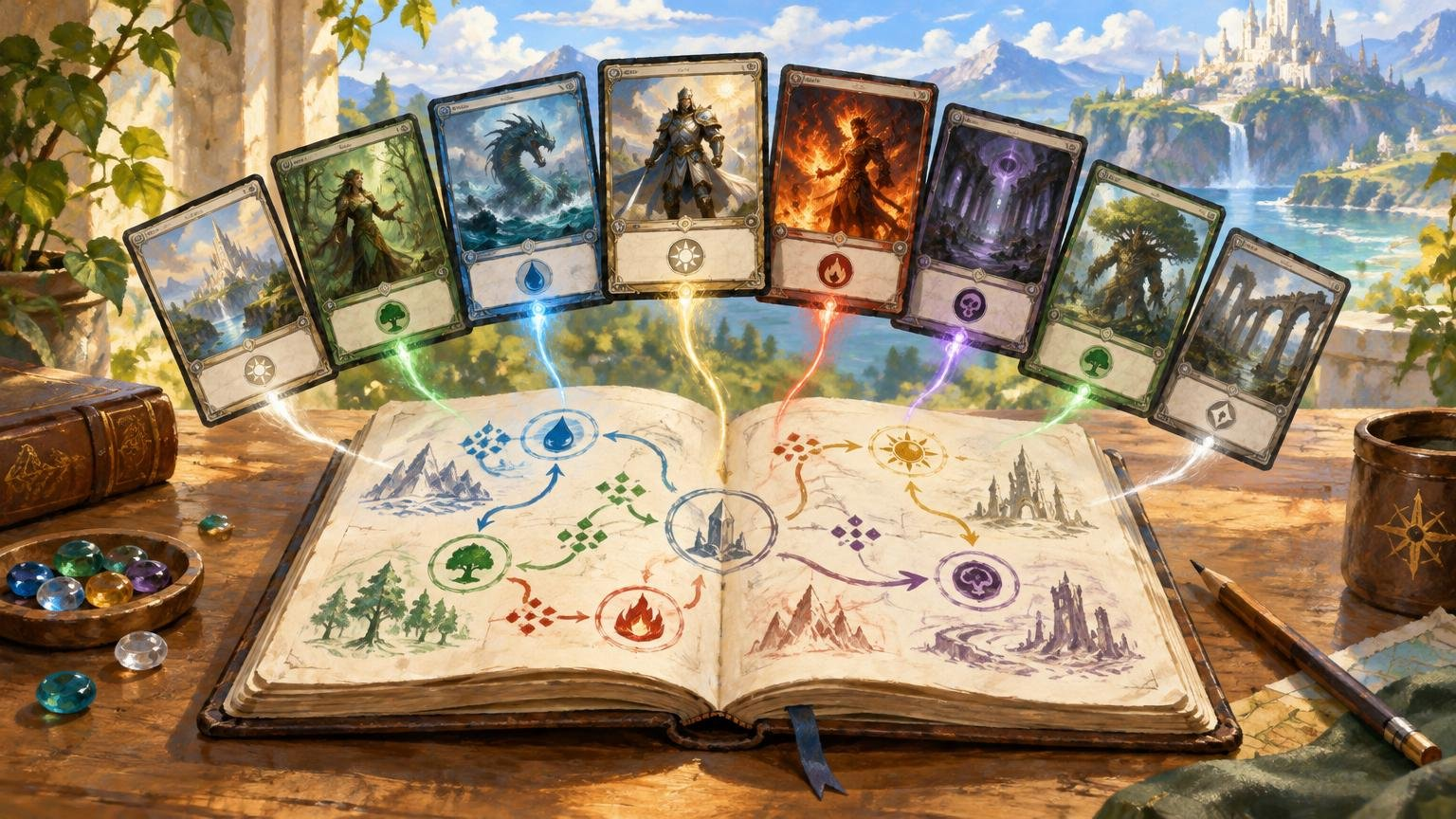
The fastest way to learn a new MTG set for Draft is not to memorize every card. Build a working map of the format, test it through practice drafts and deck construction, then revise it when actual games and useful data reveal where your assumptions were wrong.
A good sequence is: browse the full set, identify archetypes and their support, classify removal and fixing, run practice drafts, build every pool, and review early results with appropriate skepticism. This gives you enough structure to make informed picks without pretending the format has already been solved.
Your goal before the first Draft is simple: recognize the important questions. Which commons pull you toward a color? Which mechanics need several enablers? What interaction can punish you? Can the mana support a splash? What does a functional curve look like? You do not need perfect answers yet. New formats have a habit of punishing certainty more enthusiastically than ignorance.
Use a five-stage study workflow
| Stage | What to do | What you should produce |
|---|---|---|
| Browse | Scan the complete card file in several focused passes | A map of mechanics, colors and unusual effects |
| Classify | Mark signposts, enablers, removal, tricks and fixing | A compact set-analysis reference |
| Practice | Run simulated drafts with a stated goal for each session | Pick decisions and hypotheses to review |
| Build | Construct and inspect every drafted pool | A curve, mana plan and list of painful cuts |
| Update | Compare your ideas with games and sufficiently mature data | Revised card, color and archetype evaluations |
Keep these stages separate. Reading tells you what exists. Drafting tests whether you can recognize and assemble it. Deckbuilding shows whether your picks produced a coherent list. Games reveal whether that list functions. Data can then help identify patterns worth investigating.
First pass: browse the complete set without ranking everything
Start with the complete card pool rather than a tier list. A published Wizards card image gallery lets you inspect wording, rarity, color, mana cost and the fixing available in the set. Read the associated official release notes for mechanics and rules interactions that are easy to misunderstand from a quick card scan.
Do not attempt a definitive pick order during this pass. Instead, browse with one question at a time. A useful first pass covers the following:
- What are the set’s named mechanics, and which colors use them?
- Which cards create, consume or reward the set’s main resources?
- Which commons look useful without requiring a specific synergy?
- Which cards become much better only after a condition is met?
- Are there unusual combat, graveyard, token or casting interactions to remember?
- What kinds of mana fixing are available at common and uncommon?
Multiple focused passes work better than staring at several hundred cards until the names become decorative noise. The workflow in browsing a new MTG set with a Draft plan turns the card list into a practical map instead of an endurance test.
Map archetypes from signposts, then verify the support
Next, find the multicolor signpost uncommons and other obvious build-around cards. Wizards describes Draft archetypes as recurring strategies organized around shared colors and mechanics, and its set guides commonly use two-color themes and key cards to explain what each pair is trying to accomplish.
Treat those signposts as clues, not instructions. An uncommon that rewards sacrificing creatures does not prove that a sacrifice deck works. Search the commons for cheap fodder, sacrifice outlets, useful death triggers and cards that remain playable when the complete engine fails to appear.
For each likely archetype, record four things:
- Plan: how the deck expects to gain an advantage or end the game.
- Enablers: the lower-rarity cards that make its mechanic function.
- Payoffs: cards that become stronger once the plan is operating.
- Fallback cards: efficient creatures, interaction and card advantage that still work in an imperfect draw.
This distinction prevents a familiar Draft disaster: taking every card that mentions the set mechanic and discovering during deck construction that the pool contains twelve ingredients but no meal. Official Draft guidance likewise treats synergy as one concern alongside the mana base, curve, creature count, removal and card advantage.
Also leave room for discoveries outside the advertised pairs. Wizards notes that viable decks can exist beyond the initially recommended color combinations. The signposts provide a starting map; the cards passed to you still determine where you can travel. For a closer inspection method, use the workflow for identifying Draft archetypes from signpost uncommons.
Build a removal, trick and fixing reference
Once the broad archetypes make sense, classify the cards that shape ordinary games. Removal, mana base and curve remain central Limited concerns regardless of the set’s featured mechanic. A short reference is more useful than trying to remember every rating attached to every card.
Sort interaction by what it can answer
Separate unconditional removal from damage-based removal, combat tricks, bounce, tapping, counterspells and narrow sideboard effects. Record the important restrictions: mana-value limits, creature types, tapped targets, sorcery speed or the need to attack or block.
Then ask what each color struggles to answer. If a color’s common removal cannot handle large creatures, that changes both card evaluation and gameplay. If several efficient combat tricks exist, leaving a blocker back may be less protective than it looks. The purpose is not to memorize names in isolation; it is to recognize the shapes of danger represented by open mana.
Count usable fixing rather than colorful cards
Finding multicolor cards does not establish that ambitious mana bases are practical. Look for fixing among lands, mana artifacts, mana creatures, land search, filtering, token-based mana and mechanics such as landcycling. Then classify each option by rarity, color restrictions, repeatability, timing and tempo cost.
The crucial question is how much fixing appears at common and reliably encountered uncommon, because those cards determine whether a splash plan can be assembled consistently. A mythic land may be excellent fixing, but it is not an environmental policy. Use the full mana-fixing search checklist to separate real support from wishful deck registration.
Run practice drafts with one training goal
After building a rough set map, start drafting. Conventional Booster Draft uses three packs, passes left in the first pack, right in the second and left again in the third, and produces decks with a 40-card minimum. A simulator lets you repeat the pick-and-build portion without waiting for a complete live pod.
Do not use a practice draft merely to see whether the resulting deck looks powerful. Give each run one question:
- How long can I remain open before committing to a color pair?
- Which commons make me want to enter each color?
- Does a particular archetype have enough enablers at common?
- When should a strong off-color card pull me away from my early picks?
- How highly must I take fixing if I intend to splash?
- Can I finish with enough early plays and creatures without taking weak cards?
Run several drafts from different starting positions. Forcing one archetype repeatedly can teach you its card requirements, but it will not teach you how to read changing signals. Alternate between focused sessions and open drafts. The 30-minute Draft simulator training plan provides a repeatable structure when you want useful reps rather than an evening of unreviewed picks.
MTG Arena Quick Draft is another official practice option: the drafting portion uses bots and has no pick timer, while games are played against live opponents. The slower pace is useful for examining every choice, although bot behavior should not be treated as a perfect model of a human pod.
Build every pool, including the awkward ones
A practice draft is incomplete until you build the deck. Construction exposes mistakes that individual picks can hide: too few creatures, a crowded expensive slot, unsupported synergy cards, weak colored sources or a pile with excellent card quality and no plan for the first three turns.
Start by grouping cards according to their job rather than their rarity. Mark early plays, interaction, threats, card advantage, fixing, synergy enablers and payoffs. Then inspect the mana-value distribution and colored requirements. Average mana value alone misses whether you can affect the board early, cast double-colored spells on time or use your mana efficiently across several turns.
For each pool, answer these questions:
- What is the deck’s primary plan, stated in one sentence?
- Which opening hands can execute that plan?
- How many meaningful plays can the deck make early?
- Does the creature count support its combat and synergy requirements?
- Can the mana cast the important spells when they matter?
- Which cards are included only because the Draft went off course?
- What were the final three cuts, and what argument supports each one?
The final cuts are especially educational. They force you to compare role, curve and consistency rather than assigning cards abstract grades. Save the finished list and one concern to test. Examples include “the deck may lack early defense” or “the splash may cost too much tempo.” A concrete concern gives the games a purpose.
Turn early games into questions, not declarations
During your first matches, review decisions at three levels. At the card level, note which cards were difficult to deploy or weaker than expected. At the deck level, inspect curve, mana and role balance. At the format level, watch for repeated patterns such as stalled boards, aggressive starts, abundant fixing or mechanics that require more support than preview-season discussion suggested.
Avoid declaring an archetype unbeatable because one opponent assembled it perfectly. Record the observation, then look for repetition. Also separate draft failure from gameplay failure. A deck may be poorly positioned because the open lane was missed, because its build was unbalanced or because a close game contained a costly sequencing decision. “The format is bad” is rarely the most actionable diagnosis available after one match.
Use Draft data after the sample becomes informative
Once enough games and drafts have been recorded, aggregated data can challenge your first impressions. The 17Lands metric definitions include draft-stage measures such as Average Taken At and Average Last Seen At, along with game-stage measures covering opening hands, drawn cards, cards seen in hand and game results. Its public datasets contain pick-level and game-level records with information about decks, opening hands, later draws, results and user performance.
Start with questions rather than rankings. Is a card being taken much earlier than it appears to deserve? Is an archetype popular but struggling? Does a supposedly essential payoff perform only when drawn in decks with enough support? Are successful versions of a color pair built with a lower curve or a different mechanic balance than your drafts?
Always inspect sample counts and context. 17Lands presents sample sizes with its rate metrics and notes limitations in its player groupings and derived measures. Its improvement-in-hand statistic, for example, is a simple difference that can make powerful late-game cards look especially influential. These metrics identify places to investigate; they do not prove that a card caused a deck to win.
Early data is most useful when it updates a specific hypothesis. If your practice pools repeatedly lacked two-drops, check whether successful decks in that archetype also prioritize early plays. If a splash card looked impressive but strained the mana, compare how often the card is played and what fixing appears in those decks. Data should sharpen the next practice session, not replace it.
Prepare a compact plan for the first real Draft
Before joining the Draft, reduce your notes to one page. Include each color pair’s likely plan, the best common enablers, notable removal and tricks, available fixing, and two or three unresolved questions. The compact version should help you make picks; the complete card encyclopedia can stay in another tab, where it will enjoy the company of the other seventeen tabs.
During the Draft, use the map without becoming trapped by it. Take broadly useful cards early, watch which colors and roles remain available, and check whether your developing pool has a curve and mana plan. A signpost uncommon is evidence. A late run of playable commons is evidence too. The open deck is usually defined by the full stream of cards, not the first gold uncommon that made eye contact.
The best preparation does not make your first Draft flawless. It gives you a repeatable loop: inspect the set, form hypotheses, practice picks, build the pools, play games and revise the map. That loop teaches the format faster than memorizing a tier list because every step produces a question the next step can answer.