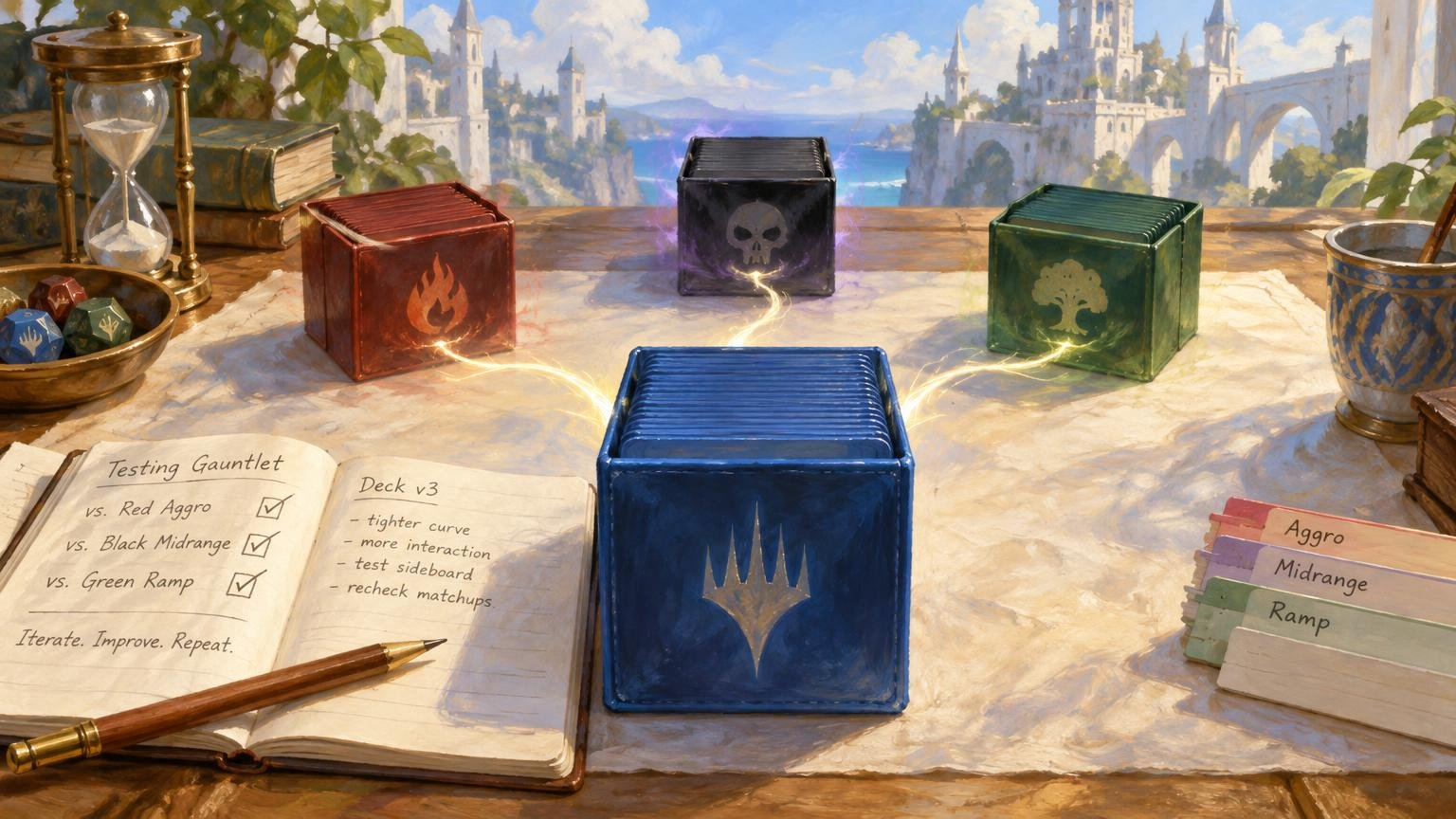
TLDR: Build an MTG testing gauntlet around the format, platform, match structure, and event you expect to play. Start with five to eight decks covering the most important strategic pressures, use current representative lists, and record preboard, postboard, play, and draw results separately. Refresh the gauntlet when legality, new sets, major results, your local field, or your own deck changes.
A useful MTG testing gauntlet is not a permanent list of whatever decks were popular when you opened a spreadsheet. It is a dated collection of representative opponents designed to answer a specific question: what does your new deck beat, what exposes it, and which changes deserve another round of testing?
The best gauntlet balances metagame popularity with matchup coverage. You need to face likely opponents, but you also need to test against distinct pressures such as fast clocks, efficient disruption, sweepers, inevitability, explosive engines, and linear strategies. Otherwise, ten decks can secretly be the same test wearing different sleeves.
What an MTG testing gauntlet should accomplish
A gauntlet is a controlled set of decks used for repeatable matchup practice. It should help you evaluate deck construction, sequencing, mulligans, sideboarding, and matchup plans under conditions that resemble your intended event.
It is not supposed to predict an entire tournament from a handful of games. Small samples are noisy, player familiarity matters, and one unusual draw can make a terrible plan look inspired. Use the gauntlet to find recurring problems and generate better hypotheses, not to declare a matchup 63.4% favored after Tuesday night’s six-game session.
Before choosing any opposing decks, define these five conditions:
- Format: Standard, Pioneer, Modern, Pauper, Legacy, or another Constructed format.
- Platform: tabletop, Magic Online, or MTG Arena.
- Match structure: Best-of-One or Best-of-Three.
- Goal: a local weekly event, a larger open tournament, ladder play, or general deck development.
- Expected field: broad online metagame, recent event field, or the players and decks common at your store.
These choices materially change the gauntlet. Arena Best-of-One rewards different configurations than tabletop Best-of-Three because sideboards, opening-game construction, and expected opponents differ. A local event may also contain more budget decks, pet archetypes, or unusually dedicated specialists than an online aggregate suggests.
Source a current metagame instead of copying an old tier list
Start with recent event results, published decklists, and format reporting. Record the dates, platform, event type, field size when available, and whether the source describes popularity, performance, or only successful finishes. Those are different measurements.
The methodology in Magic.gg’s July 2026 Standard metagame analysis is a useful model: it defined a July 1–23 window, examined more than 900 successful lists, and used both Magic Online Challenges and a 135-player tabletop event. That does not make its lineup permanent; it demonstrates why a metagame claim needs a date and a stated sample.
Popularity tells you what you are likely to encounter. Performance can identify decks that convert their appearances into strong results. Strategic role catches threats that may be uncommon but uniquely difficult for your deck. A practical gauntlet considers all three.
| Selection signal | What it tells you | How to use it |
|---|---|---|
| Metagame share | How frequently an archetype appears in the measured field | Give frequent decks more testing time |
| Recent performance | Which decks posted strong results in the selected sample | Check whether your plan survives proven configurations |
| Strategic role | Which pressure or interaction pattern the deck represents | Prevent blind spots even when an archetype is less common |
| Local frequency | What you are likely to face at your actual event | Adjust repetitions and sideboard preparation |
Before importing any list, check the live Wizards Banned & Restricted list. Constructed legality applies to both main decks and sideboards, and an effective ban or unban can invalidate old lists immediately.
Choose representative archetypes by matchup texture
For a first pass, build a compact gauntlet of five to eight decks. The number is a workflow recommendation rather than a law: it is usually broad enough to reveal major weaknesses without turning preparation into a second job.
Try to cover the following pressures where they exist in your format:
- Aggro or tempo: asks whether you affect the game early enough and whether your mana cooperates under pressure.
- Board-based midrange: tests card quality, combat, removal efficiency, and your ability to break stalled boards.
- Control: tests threat deployment, resilience to sweepers, card advantage, and postboard patience.
- Ramp or inevitability: gives you a clock and punishes plans that generate activity without closing the game.
- Combo or engine: tests disruption density, interaction timing, and whether your own clock is meaningful.
- Relevant linear strategy: graveyard, artifacts, lands, go-wide creatures, or another axis requiring specialized answers.
Do not add separate decks merely because their archetype names differ. Add another variant when it changes the actual matchup: its clock is faster, its threats demand different answers, its interaction attacks a different resource, or its sideboard plan changes how games play.
Conversely, do not let one generic “control deck” stand in for every slow strategy if the format contains both tap-out control and a draw-go list with very different pressure points. The purpose is representative coverage, not perfect taxonomy.
Use current lists and annotate their important choices
A gauntlet deck should resemble a list a prepared opponent might register. Import a recent representative list rather than reconstructing an archetype from memory. The plain-text decklist import workflow can reduce transcription errors, while an MTG deck builder gives you a stable place to preserve each opposing list.
For every gauntlet deck, record the archetype, source date, event or platform, main-deck version, sideboard, and unusual configuration choices. If a list cuts a customary threat for extra removal, that detail may explain your results better than the archetype label does.
Use a competent pilot whenever possible. A poorly sequenced combo deck or control list can produce comforting but useless results. If both players are learning the matchup, note that and switch sides periodically. Playing the opposing deck often reveals what it fears more clearly than another ten games from your preferred seat.
Test coverage, not just total wins
Separate games into meaningful buckets. At minimum, distinguish preboard from postboard and play from draw. Mixing them hides useful information: a deck may survive game one but collapse after targeted sideboard cards arrive, or it may function on the play while consistently falling one turn behind on the draw.
Use an intentional testing sequence:
- Play a small preboard set from both play and draw positions.
- Write down the matchup hypothesis: your role, critical turns, key cards, and expected failure point.
- Build sideboard plans for both decks before beginning postboard games.
- Test postboard games from both positions without silently changing the plan after every loss.
- Review decisions and recurring patterns before editing the deck.
- Change one package or a small number of connected cards, create a new version, and retest the targeted question.
A matchup log should capture more than wins and losses. Record mulligans, play or draw, preboard or postboard, deck versions, sideboard plan, the turn the game became effectively decided, cards stranded in hand, mana problems, and the next question to test.
For example, “lost to aggro” is not actionable. “On the draw, the deck had no meaningful turn-two play in four games, and its first stabilizing spell competed with a tapped land” points toward curve, mana, or interaction changes. Use a mana-curve review to check for early-play gaps, but remember that a curve graph diagnoses structure rather than proving a competitive fix. MTG App describes its analyzer as a way to surface high-cost concentration and gaps in early plays.
Track deck versions before judging a change
Do not overwrite your list and trust your memory. Preserve a baseline, label each revision, and state what the change is supposed to improve. A simple deck version log prevents results from several different builds being blended into one imaginary deck.
Suppose you replace two expensive threats with cheap interaction. Your hypothesis might be: “This should improve on-the-draw games against fast creature decks without materially weakening control.” Retest those matchups first. If you simultaneously change ten cards, the mana base, and the sideboard, you may improve—but you will not know why.
Prioritize breadth before repetition. Run enough initial games to expose obvious structural failures across the field, then invest more games in common, close, or confusing matchups. A matchup that is clearly disastrous because your deck cannot interact with the opponent’s core engine needs a design response before it needs fifty more repetitions.
Refresh the gauntlet when the format moves
Treat every gauntlet as dated. Review it after a new set enters the format, a Banned & Restricted change takes effect, major events reveal new decks or configurations, your local field shifts, or your deck undergoes a substantial revision.
Rotation schedules matter too. Wizards stated that Standard would not rotate in fall 2026 and scheduled the next annual rotation for early 2027, so a Standard gauntlet built during that period should use the actual legality timeline rather than assuming the older fall pattern.
Refreshing does not mean rebuilding everything after every tournament. Compare new evidence with your current lineup. Update representative lists, replace declining archetypes, and add emerging strategies when they create a genuinely new matchup. Keep older versions archived so you can tell whether the field changed or your testing simply did.
Practical access and format caveats
You do not need to own every tournament deck to run private tests. Digital lists, borrowed cards, placeholder cards, or playtest prints can make a broad gauntlet practical. If card access is the bottleneck, MTG playtest proxy options can support private matchup testing; use event-approved cards and accessories when preparing for sanctioned play.
Commander needs a different model. Some ideas transfer—version tracking, testing assumptions, and identifying strategic pressure—but a two-player matchup matrix does not capture multiplayer politics, pod composition, commander visibility, or power expectations. For Commander, build representative pods and scenarios rather than pretending that a 60-card Constructed gauntlet maps cleanly onto four-player games.
Build the smallest gauntlet that answers your real question
Begin with five to eight current decks chosen for frequency, performance, and strategic coverage. Annotate every list, test preboard and postboard on both play and draw, and log why games turn rather than only who wins. Then use those observations to make narrow deck changes and targeted retests.
The goal is not to own a museum of metagame decks. It is to maintain a useful instrument. Date it, question it, and refresh it whenever the format or your intended event changes. That process will tell you far more than repeatedly goldfishing and hoping the opponent politely declines to participate.