How Many Games Should You Play Before Changing an MTG Deck?
There is no universal game count that proves an MTG deck needs a change. Diagnose the type of problem, test it under relevant conditions, and make the smallest coherent revision.
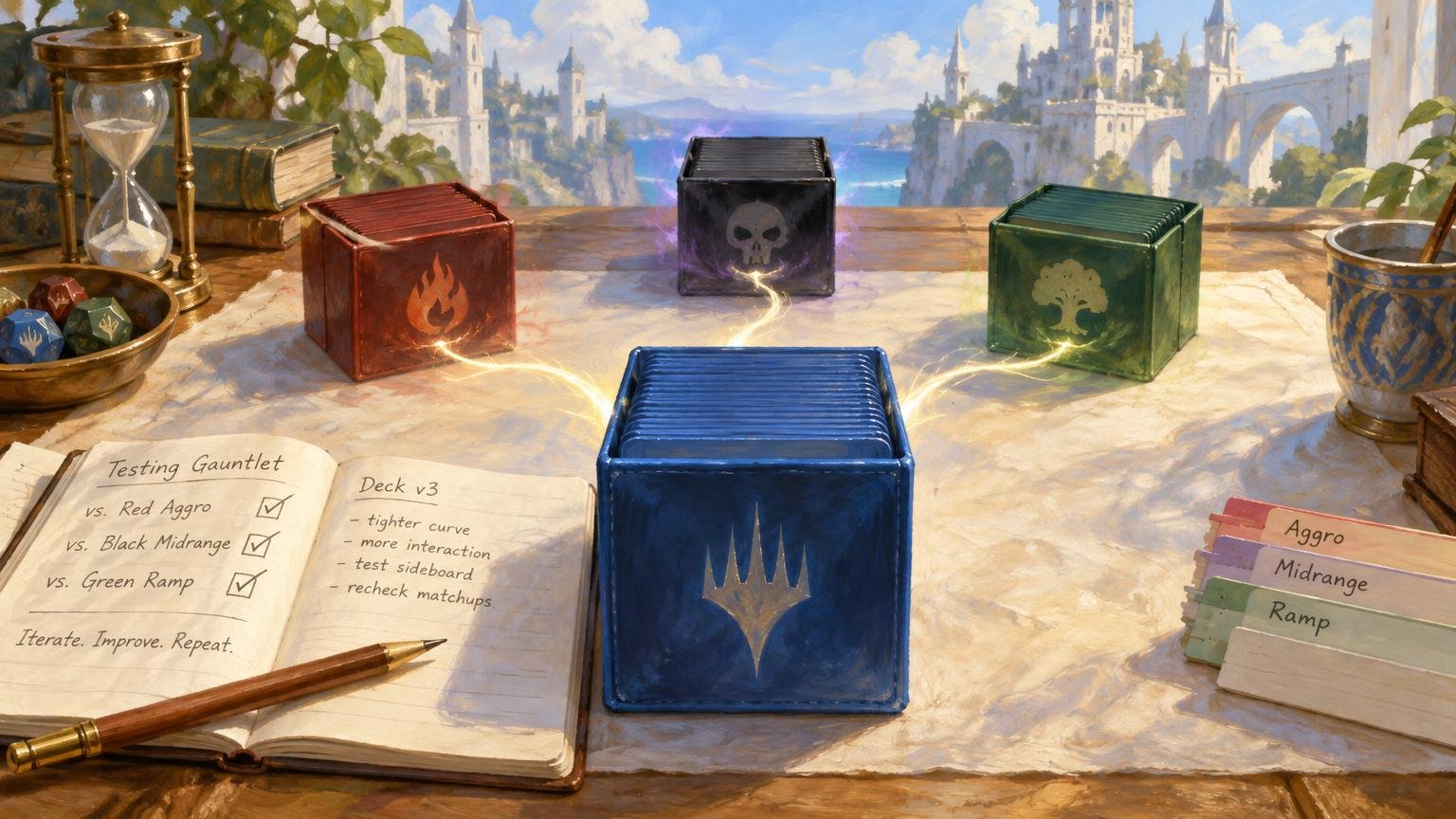

A practical workflow for selecting representative decks, testing preboard and postboard matchups, recording useful results, and refreshing your gauntlet.
Learn how to identify the set of a physical Magic card, find every printing by name, decode set and collector numbers, and separate reprints from variants.
A practical workflow for finding every printing of a Magic card, identifying a physical copy, and separating true reprints from alternate treatments and similar cards.
Use a simple deck version log to record each edit, its purpose, its structural effects, and the evidence needed to keep or reverse it.
Learn how to evaluate Pack 1, Pick 1 using raw power, color commitment, archetype dependence, replacement level, and flexibility, then test your reasoning through complete simulated drafts.
Use a simple quantity-plus-card-name format to move an MTG decklist between tools, then check card totals, unresolved names, and deck sections before playing.
A top-heavy mana curve may be the problem, but weak ramp, missed land drops, color requirements, or empty early turns can create the same symptoms. Use this workflow to find the actual bottleneck before cutting every expensive spell.
A deck builder manages the list; a mana curve analyzer diagnoses how its costs and casting demands are distributed. Here is how to use both in one practical tuning loop.
Combo redundancy is not simply adding more combos or tutors. It is the deliberate use of shared pieces, valid substitutes, and overlapping lines that give a deck more ways to assemble a win without wasting slots.